Why the client wanted leadership training for their pharma sales managers
The client's L&D team approached Mind Makers with a familiar problem in field-heavy sales organisations: their regional business managers had been promoted on the strength of their numbers, not on their ability to lead.
They were strong individual performers now responsible for teams — expected to set goals, delegate, give feedback and hold difficult conversations, with no structured grounding in any of it. Generic leadership content had not worked before. The brief was explicit: build something that speaks the language of a pharma field force.
Designing a customised sales leadership programme
How our training programs are designed around your field force, your counters and your daily reality.
We built the programme from scratch rather than adapting a template.
A custom participant workbook
A full RBM Excellence Workshop workbook covering managerial identity, non-verbal impact, listening and questioning, assertive communication, goal-setting, delegation and performance conversations — structured as working exercises, not reading material. Participants left with a completed document, not a set of notes.
Company-specific scenarios
Every role-play and case discussion was written around situations these managers actually face — their products, their territories, their team dynamics. No generic "imagine you manage a sales team" prompts.
Reference flashcards
Key frameworks were produced as standalone desk cards, so the tools stay visible long after the workshop ends.
A field-day time exercise built from their own reality
Rather than teach time management in the abstract, we wrote a full minute-by-minute time log of a regional business manager on a joint working day — arriving at the first market at 10:00, moving between chemist counters and a distributor, and finally packing up at 6:30 p.m. instead of 5:00.
Groups sorted every activity into within control, partially controllable and beyond control, then defended a decision on each line: could this time have been shortened, and by how many minutes?
The design choice that mattered is the one most exercises get wrong. We deliberately built in time that genuinely had to be cut — long gaps between appointments, waiting past scheduled start times, unplanned detours, and low-value stops that could be batched or removed. We also left in time that should be kept — the wait at a counter while the chemist finishes billing, the on-the-job feedback to the sales officer, the distributor's order and outstanding discussion, lunch. The point was never to strip the day down for the sake of speed; it was to teach them that time management is about judgment — knowing what to keep, what to trim, and being able to justify either decision.
Because every line had to be justified out loud, the debate itself became the learning. Some groups chose to trim a stretch of the day, others argued for keeping it exactly as it was — either answer was accepted, as long as the reasoning held.
At the end of the exercise the participants pointed out something we had hoped they would notice on their own: this was not a random day in a random person's life. It was their own daily schedule. They found it both impressive and genuinely useful for the way they plan their days.
Behavioural style and influence content
Managers were given a shared vocabulary for reading the people they lead and sell to — a four-style model, what motivates each, and how to adjust approach accordingly.
Inside the workbook
The workbook is the working surface of the two days — every framework is followed immediately by a page the participant has to fill in.
Seven questions to open the programme
- What are the 3 things I am looking at, by [year]?
- What 2 things have blocked my progress so far?
- What 2 things, if done consistently even now, would make a huge difference to my life?
- What do I want to stop doing, if I want to be more effective and efficient?
- With everything on my plate, what should I block out time for to get better results at work?
- Is there anything I know should be done, that I have not yet acted upon?
- In the time zones of past, present and future — where do I spend most of my time?
Before any content, before any model, each manager answers these.
The GROW model, with the actual questions
Most programmes teach the acronym; we hand over the wording.
Goal
- “What do you want to be different in 90 days?”
- “How will you know you have got there?”
Reality
- “What is happening right now, in facts?”
- “What have you already tried?”
Options
- “What else could you do, even if imperfect?”
- “If a colleague you respect were in this seat, what would they try?”
Will
- “What will you do, and by when?”
- “What support do you need from me?”
| Start | Stop | Continue |
|---|---|---|
The last page every participant fills in before the room breaks up. Not learnings — behaviours.
What made it different: an individual feedback report for every participant
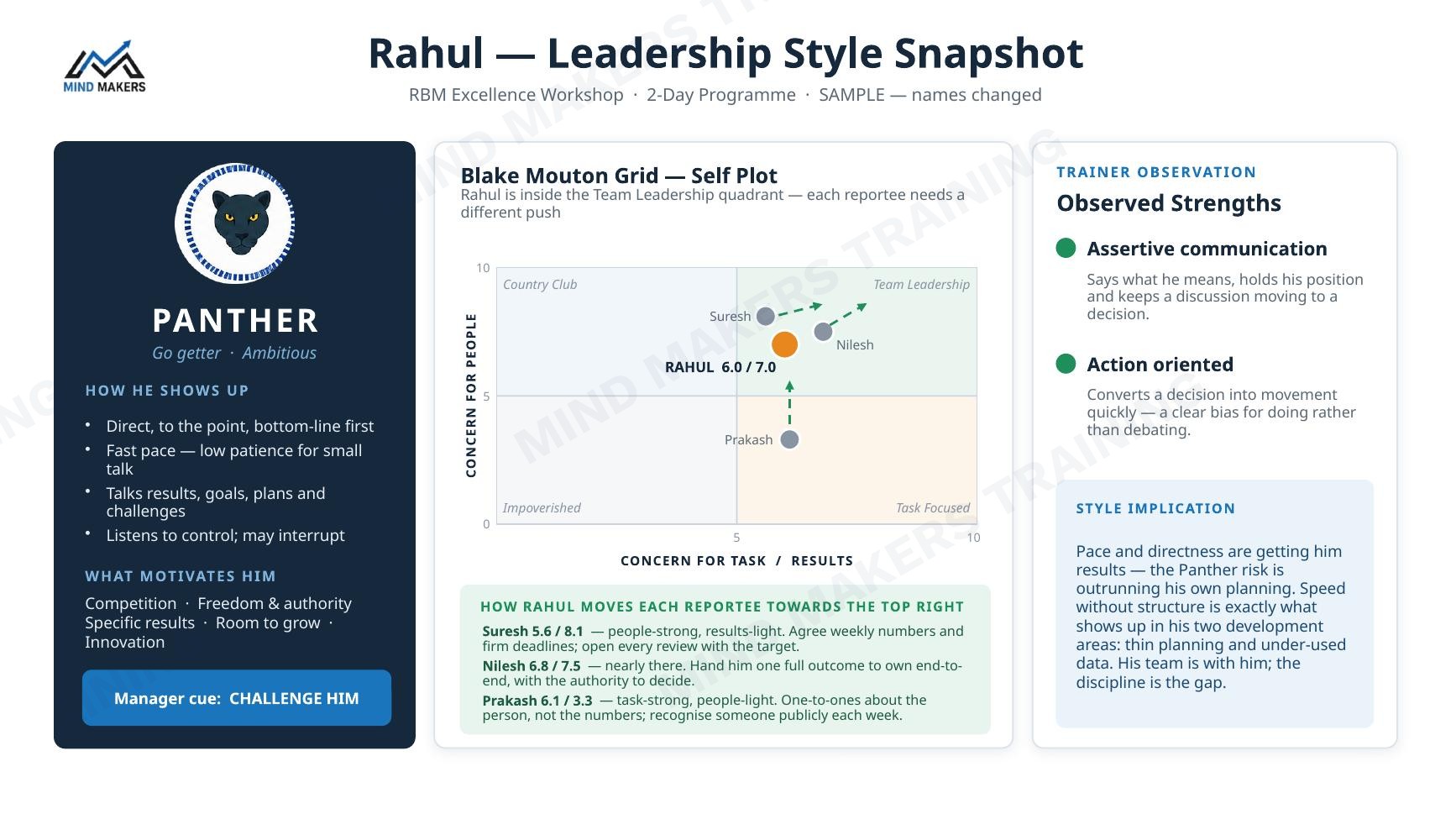
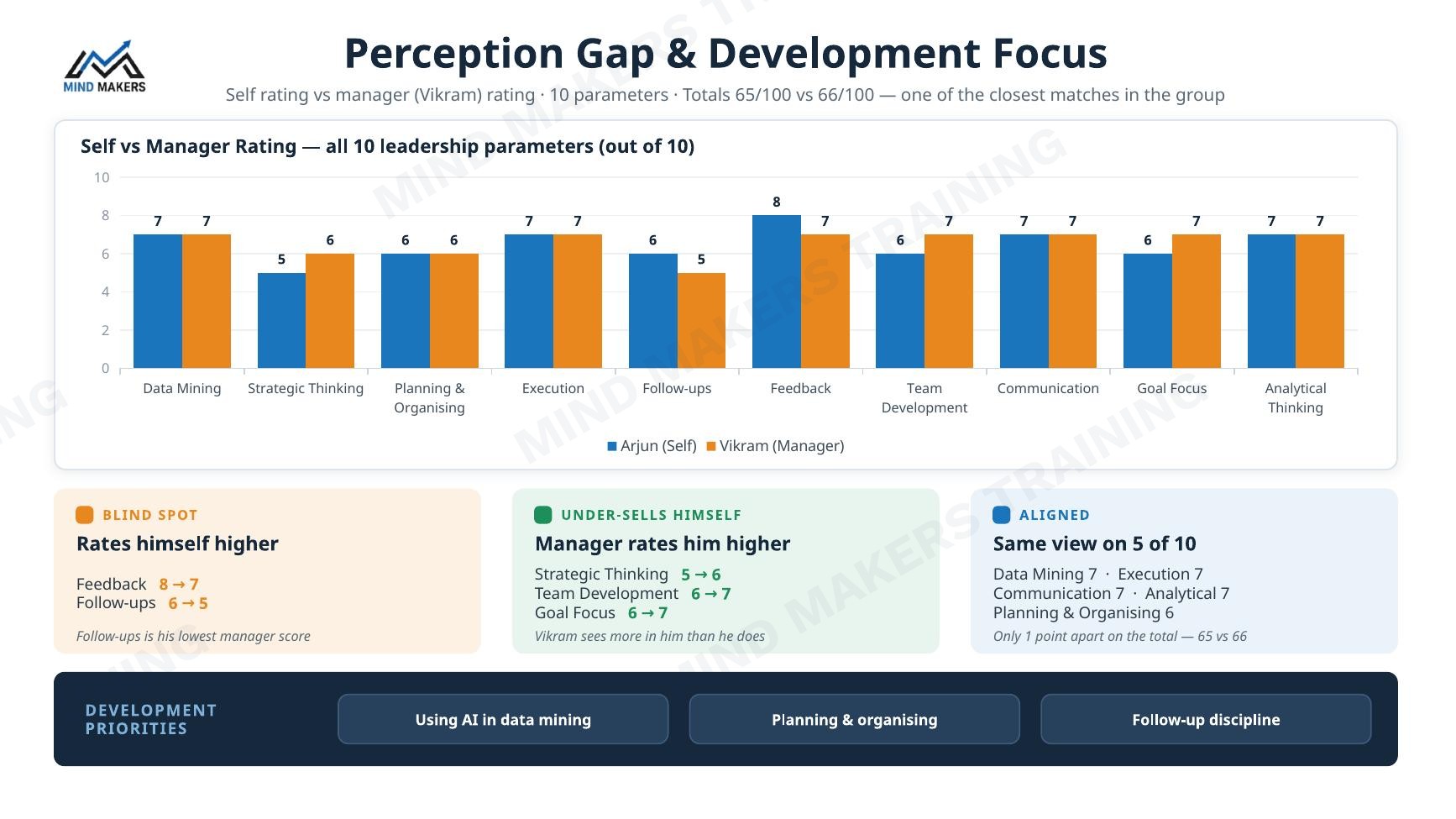
Most workshops end with a feedback form. This one ended with a two-page individual report for each of the ten participants, containing a behavioural style profile, their Blake-Mouton plot with every direct report mapped alongside them, a named coaching action for each reportee, trainer observations, a self-versus-manager perception gap analysis across ten leadership parameters, and three development priorities drawn from the data.
One participant scored himself two out of ten on communication; his manager scored him four, and the trainer's own observation was that communication was among his clearest strengths. Across the group, more managers under-rated themselves than over-rated themselves — not what the L&D team expected, and it changed how they framed the conversation with the business.
Sample report. Names and identifying details changed.
The result
The client asked Mind Makers to run the programme for their area sales manager population.
For a training partner, a repeat mandate from the same L&D team — for a different audience, on the strength of the first delivery — is the only feedback metric that matters.
Why it worked
- We designed for their business, not for the topic. The scenarios, the language and the examples came from their world — a chemist counter, a distributor's office, a joint working day.
- We gave managers a mirror, not a lecture. Every participant left with a specific, evidenced picture of themselves, including things their manager had never said out loud.
- We made it actionable at the reportee level. A manager did not leave with "delegate better." He left with a named person, a named behaviour, and a first step.
- We left artefacts behind. A workbook each manager filled in himself, and a set of desk flashcards.