Negotiation Skills Workshop: ₹57 Lakh+ in Procurement Cost Savings
How our negotiation skills training, built on the team's own live cases, helped a manufacturing procurement team negotiate with data, confidence and a plan.

- Industry
- Electronics & consumer durables manufacturing
- Participants
- 75 procurement professionals
- Format
- Discovery call & pre-assessment + 2-day negotiation skills workshop + 45-day booster programme + individual calls with live action learning + post-assessment on the Action Learning Programme
- Results
- ₹57 lakh+ for the projected year
The challenge
Our client's procurement team was negotiating under pressure from every side. Commodity prices were volatile, they relied on several sole-source suppliers, and urgent negotiations left little time to prepare. Suppliers were pushing price increases without clear cost breakdowns, and the risk of supplier failure was always present.
Our discovery call and pre-assessment confirmed the gaps. The team needed stronger vendor negotiation skills for hard situations, sharper cost analysis and pricing, a value engineering mindset, better supplier risk management, and a clear process framework.
Our approach
We designed a four-stage negotiation skills training journey around the team's real work, so the learning would carry straight back into live supplier conversations.
Step 1: Discovery call and pre-assessment
We started with a discovery call to understand the team's context, the scenarios they faced, and their biggest pain points. Participants also completed a pre-assessment that set a baseline. After the call, we designed live case studies based on the team's actual supplier situations, so every exercise reflected negotiations they were really handling.
Step 2: Two-day negotiation skills workshop
We used the principled negotiation model from Getting to Yes and applied it to procurement. The workshop covered:
- BATNA and ZOPA training: preparing with BATNA, WATNA, walk-away price and the zone of possible agreement
- Handling single-source suppliers
- Negotiation tactics for highly volatile markets
- Managing urgent negotiations without giving away value
- Value engineering as a negotiation lever
- Planning for and negotiating through supplier failure
- Cost analysis and pricing, including cost breakdowns and total cost of ownership
- Risk mitigation in supplier agreements
- Using AI in negotiations for preparation, data analysis and scenario planning
- Moving beyond price to payment terms, volumes, delivery, warranty and service levels
- Table tactics: recognising and countering deliberate deception, escalating demands, intentional delay, the flinch, the anchor and the nibble
- Assertive, data-backed communication and conditional concessions ("If we…, can you…?")
Every module was practised using the team's own live cases and scenarios, through role-plays, case studies and group activities.
Step 3: 45-day booster programme
Forty-five days after the workshop, we returned to the participants for a booster cum impact assessment. We reinforced the skills, worked through negotiations they were handling at the time, and measured what had changed on the job.
Step 4: Individual calls and live action learning
We followed the booster with individual calls. Each participant applied the frameworks to a live negotiation, with our support, through action learning.
The results (₹57 lakh+ for the projected year)
assessed participants reported measurable procurement cost savings
in procurement cost savings for the projected year
average Skill Application Index
now lead high-leverage supplier negotiations independently
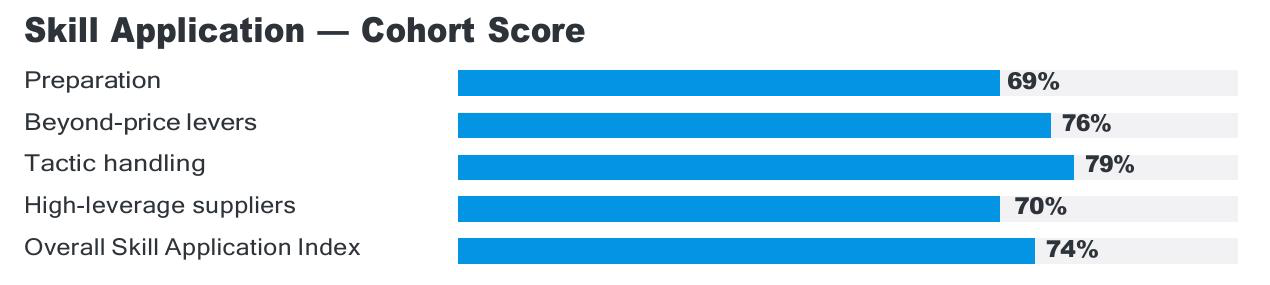
Based on participants who completed the post-training impact assessment. Savings are self-reported and calculated conservatively, using the lower limit of each savings band.
- 12 participants saved more than ₹2 lakh each, and 4 saved more than ₹10 lakh each
- 15 of 22 now regularly trade on terms beyond price
- 15 of 22 prepare with BATNA and WATNA for most or all negotiations
- 15 of 22 can name a table tactic as it happens and respond with a planned counter
What changed on the ground
Because the training was built on their own live cases, participants applied it immediately. They stopped treating unit price as the only variable. They began looking at freight, MOQs, payment terms and expediting costs, and they challenged supplier price and lead-time claims with data.
Concessions became conditional instead of automatic. When suppliers used pressure tactics, participants paused and brought the conversation back to facts and options.
What's next
The impact assessment also showed us where to focus reinforcement:
- Building independence with single-source and volatile-price suppliers
- Strengthening emotional control in the moment
- Setting up a simple savings log so every gain is captured, whether it comes from price, terms, freight or avoided expediting
Want results like these for your procurement or sales teams?
Let's talk about a negotiation skills workshop built around your team's real challenges and live cases.
Talk to us